Catheter change at home: who can do it and what to expect

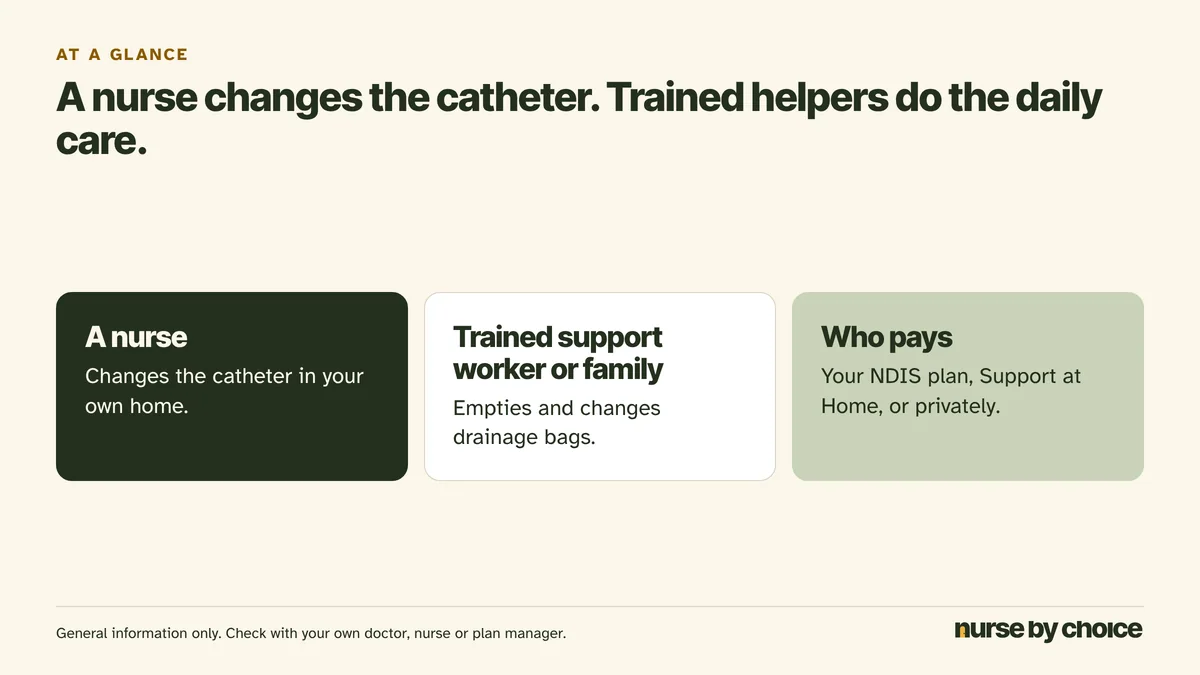
You don’t have to go to a clinic to have your catheter changed. A nurse can change a suprapubic or urethral catheter in your own home, on a day and time that suits you. The NDIS says plainly that “only a nurse can change a urinary catheter”, so this is a nursing job, not a support worker task.
Key points
- A catheter change is a nursing task. Support workers and family can help with everyday bag care once a nurse has trained them.
- A suprapubic catheter’s opening needs time to heal before its first change. Ask your urology team who does that first one.
- A catheter that falls out is urgent. Call your nurse or doctor straight away.
- The NDIS, Support at Home, or private payment can cover a home visit.
Who can change a catheter at home?
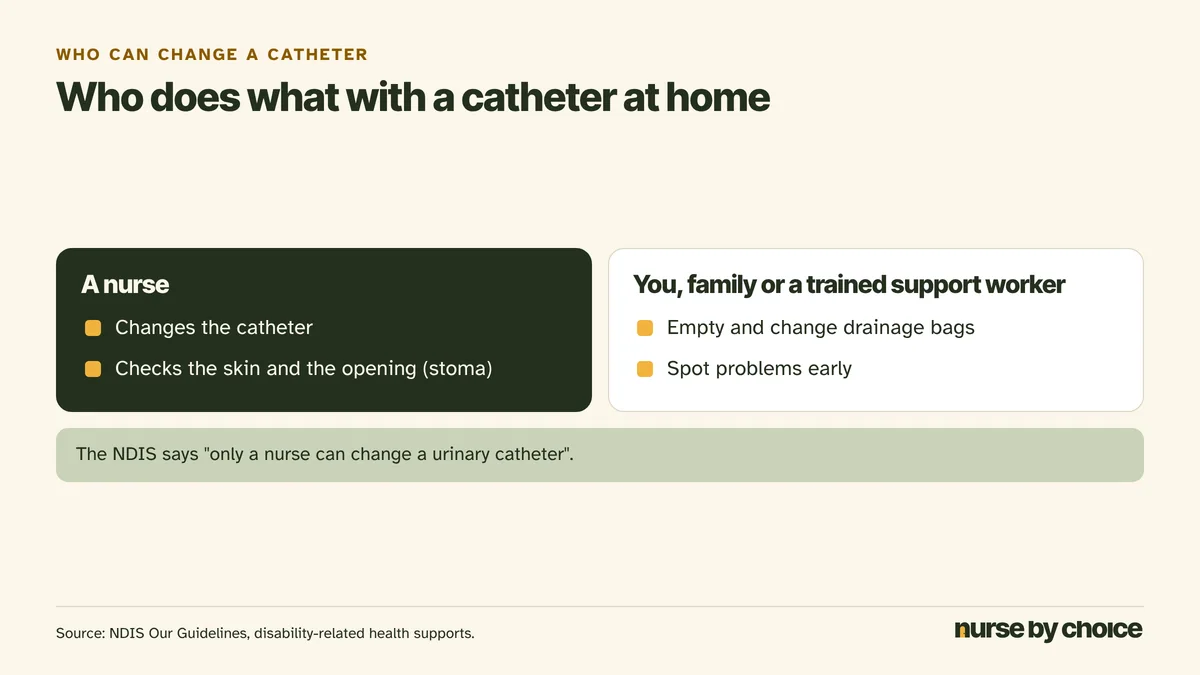
A registered nurse or enrolled nurse. The National Disability Insurance Agency (NDIA) guidelines on disability-related health supports (PDF) list catheter changes as a task that must stay with a nurse. Their continence supports guidelines (PDF) say: “We can fund a nurse to change or clean your catheter.”
Everyday catheter care is different. Emptying the leg bag, switching to a night bag, and keeping the bag and tubing clean can usually be done by you, your family, or a support worker. The NDIA says a nurse can train the people around you to help, and the NDIS may fund that training.
So a common set-up looks like this:
| Task | Who usually does it |
|---|---|
| Changing the catheter | A nurse |
| Checking the skin and the opening (stoma) | A nurse, with a trained worker watching day to day |
| Emptying and changing drainage bags | You, family, or a trained support worker |
| Spotting problems early | Everyone who helps you |
Suprapubic catheter change: what’s different
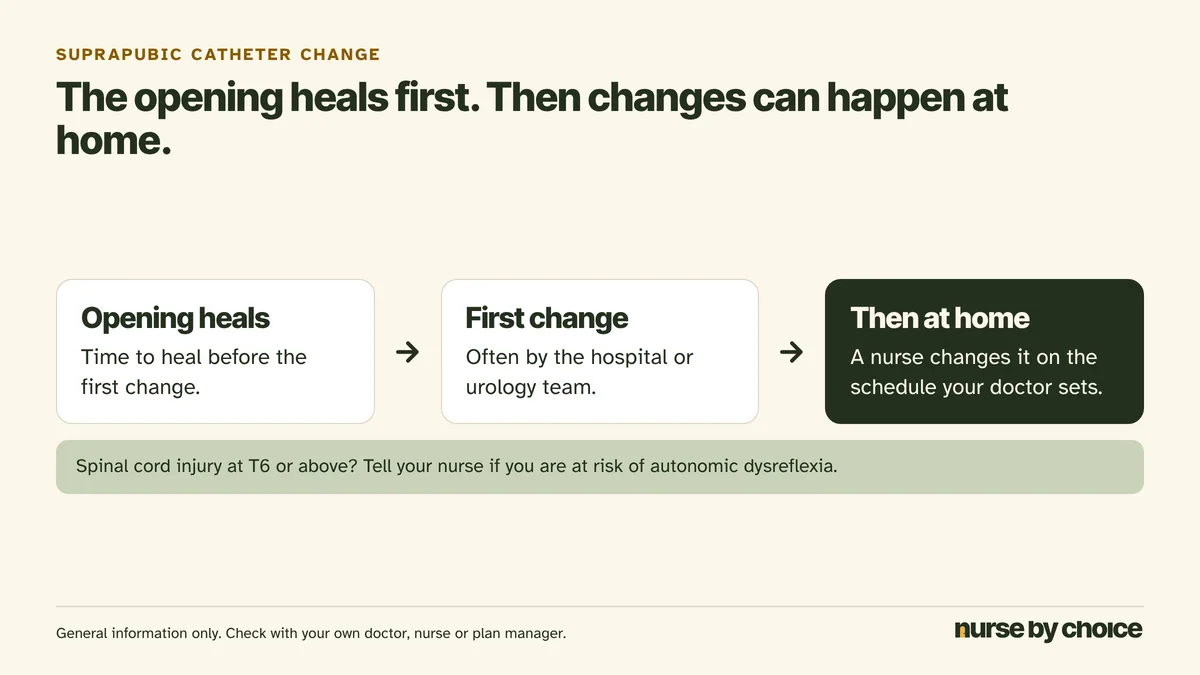
A suprapubic catheter goes into your bladder through a small opening in your lower tummy, not through the urethra. Queensland’s spinal cord injury service guide on indwelling catheters notes that the opening “must be given time to heal prior to the first SPC change”. Many people have that first change done by their hospital or urology team. After that, changes can happen at home.
How often you need a change depends on your catheter type and what your doctor or urology team has said. We work from their instructions, record every change, and book the next one before we leave, so it never sneaks up on you.
People with a spinal cord injury at T6 or above can get autonomic dysreflexia during a change: a sudden pounding headache, flushing or sweating above the injury. Tell your nurse if you’re at risk, so they watch for it and know your plan.
What happens at a home visit
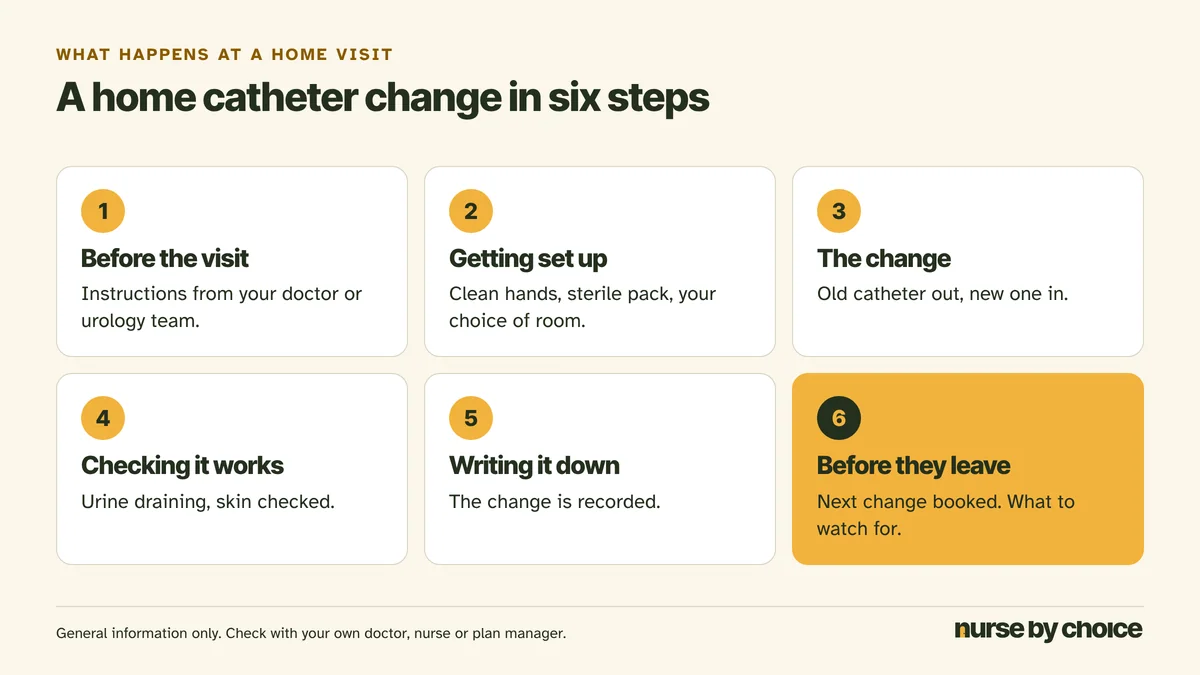
Most catheter change visits follow the same pattern:
- Before the visit. We get the details from your doctor or urology team: the catheter type, size and how often it should be changed. You or your supplier have the new catheter and bags ready.
- Getting set up. The nurse washes their hands, sets out a sterile pack and gets you comfortable. You choose the room and who stays with you.
- The change. The nurse removes the old catheter and puts in the new one using clean technique. It usually takes a few minutes once everything is ready.
- Checking it works. The nurse checks that urine is draining and looks at the skin around the opening.
- Writing it down. The nurse records the change and books the next one.
- Before they leave. You, your family or your worker get a quick refresher on what to watch for and who to call.
When to call for help
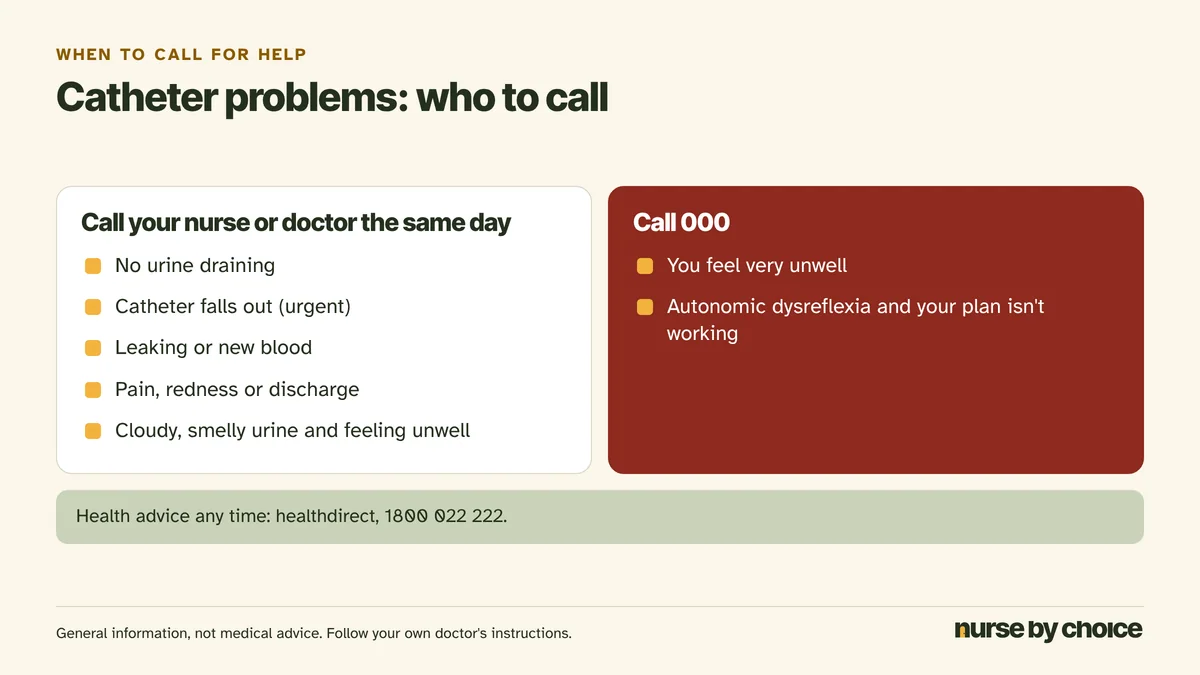
Call your nurse or doctor the same day if:
- no urine is draining, or the bag stays empty for longer than usual
- the catheter falls out (this is urgent, because the opening can start to close)
- urine leaks around the catheter, or there is new blood in the urine
- there is new pain, redness or discharge around the opening
- urine turns cloudy or smelly and you feel unwell, hot or shivery
Call 000 if you feel very unwell, or if you have signs of autonomic dysreflexia and your usual plan isn’t working. For health advice any time, you can call healthdirect on 1800 022 222.
Who pays for a catheter change at home?
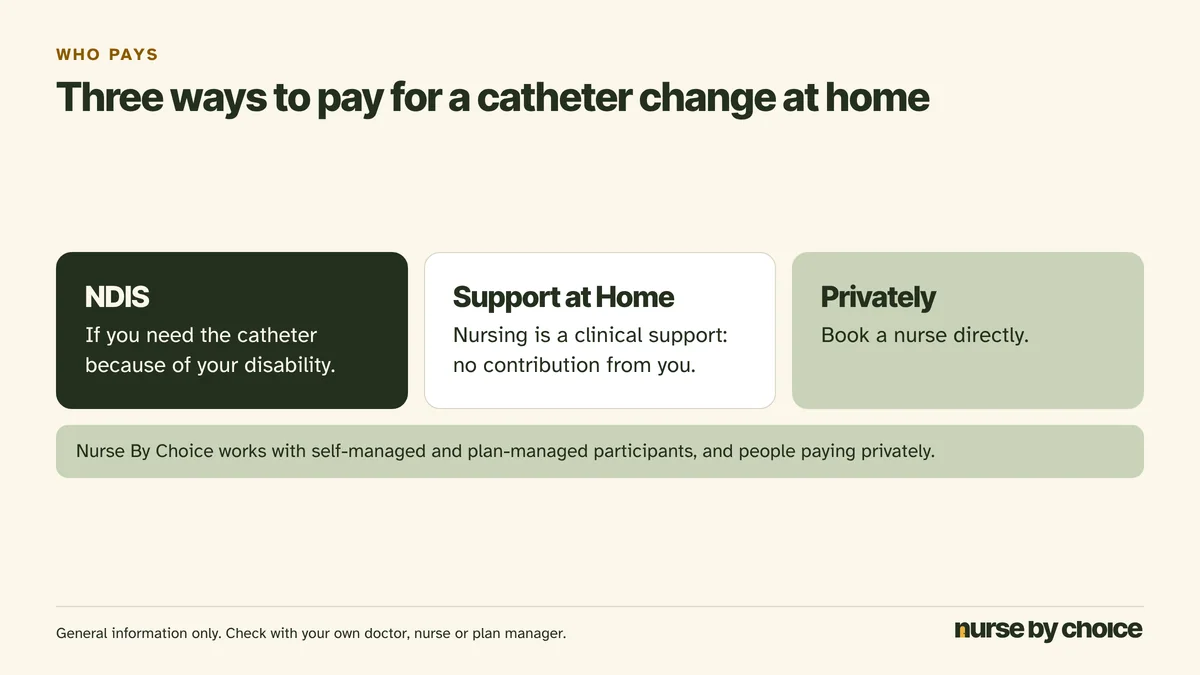
The NDIS. If you need a catheter because of your disability, the NDIS may fund a nurse for catheter changes as a disability-related health support. It may also fund the catheter supplies themselves, such as collection bags and straps. A nurse can bill this from your plan. See what NDIS nursing costs for current price limits.
Support at Home (aged care). If you’re 65 or older and have a Support at Home budget, nursing is a clinical support. The Department of Health, Disability and Ageing says people “will not contribute to the cost of clinical supports, such as nursing care” (Support at Home participant contributions). Your registered aged care provider arranges the nurse. We see older people as private clients.
Paying privately. You can book a nurse privately. Email admin@
Nurse By Choice is an unregistered NDIS provider. We work with self-managed and plan-managed participants, and with people paying privately. If the NDIA manages your plan, we can’t bill it, but your support coordinator can talk to you about switching to plan management.
Questions people ask
Can a support worker change my catheter?
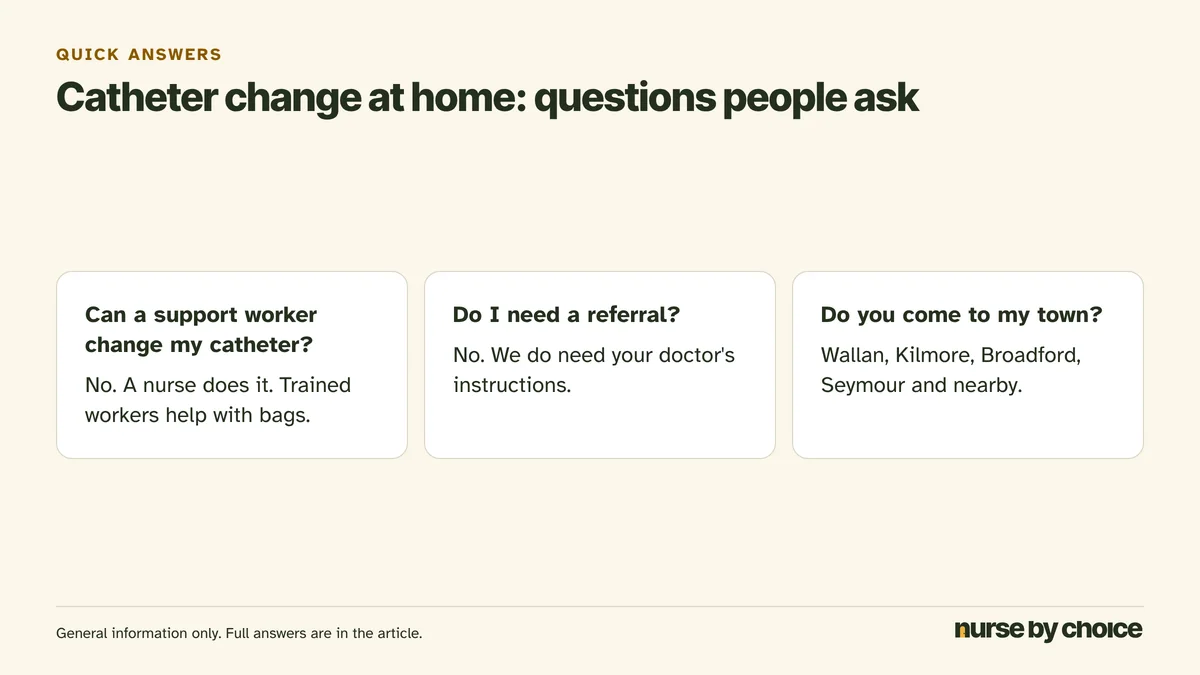
No. A catheter change stays with a nurse. A support worker who has been trained by a nurse can help with everyday care like emptying and changing bags.
Do I need a referral?
Not to book with us if you’re self-managed, plan-managed or paying privately. We do need the instructions from your doctor or urology team before we change a catheter.
Do you come to my town?
We visit homes in Wallan, Kilmore, Broadford, Seymour and nearby towns in Mitchell Shire. Check our continence and catheter nursing page for the full area.
How long does a visit take?
Usually 30 to 45 minutes, including set-up and checks. The first visit takes longer because we get to know you and your routine.
Book a catheter change at home
If you’d like a nurse to come to you, tell us your catheter type and when your next change is due. We’ll work with your doctor’s instructions, come at a time you choose, and leave you with the next date booked.
Book a home catheter change or email admin@
You can also read about our continence and catheter nursing service. If a continence assessment hasn’t been done yet, our guide to the NDIS continence assessment explains how it works.
This is general information, not medical advice. Always follow the instructions from your own doctor or urology team.